
The 5-Step Social Media Strategy That Actually Drives Sales
Introduction: It’s Time to Make Money on Social Media
How many times have you celebrated a post that received thousands of likes, only to find that your bank account hasn’t changed? For too long, social media has been viewed as a popularity contest that focuses on “vanity metrics” which look impressive but don’t help your finances.
This is changing now. Your social accounts aren’t just for sharing beautiful pictures; they serve as a direct and measurable way to generate sales. This guide outlines five key steps to convert your social media presence into a dependable source of income. We will concentrate on the only figures that count: your spending and your earnings.
Step 1: Set Goals That Directly Impact Your Cash Register
Many businesses start with a goal like “Get 10,000 followers.” That’s not useful. Instead, we need goals that connect directly to your business’s financial health.
Think of your goals using the S.M.A.R.T. framework—Specific, Measurable, Achievable, Relevant, and Time-bound—but make the “R” stand for Revenue.
Tying Your Posts to Your Sales Funnel
Every piece of content fits into one of three stages of the customer journey, and each stage needs a money-driven goal:
- Awareness (Top of Funnel): Your objective here is to get qualified eyes on your content. You measure this by the number of people who see your posts (Reach) and whether those people match your ideal customer profile.
2. Consideration (Middle of Funnel): Your goal is to spark interest that leads to an action signaling buying intent, like clicking a link to your website or signing up for an email list. You measure this by your Click-Through Rate (CTR)—the percentage of people who click.
3. Conversion (Bottom of Funnel): This is the finish line. Your goal is a direct purchase, a request for a demo, or a qualified sales lead. Here, you track your Conversion Rate and your Cost Per Acquisition (CPA)—the total cost to gain one paying customer.
The Golden Rule: Instead of aiming to “get more leads,” aim to “Generate 100 qualified sales leads from LinkedIn this quarter at a cost of less than $50 per lead.” This specific goal pushes you to track the right data and spend money wisely.
Step 2: Stop Guessing Who You’re Talking To
If you try to market to everyone, you end up marketing to no one. Successful sales strategies require focus. You must stop guessing your audience and start researching their interests, worries, and motivations for buying.
Digging Deep into the Buyer’s Mind
Your audience research needs to go beyond simple facts like age and location. You should outline the journey from a person’s pain points to their purchases.
What are their biggest problems? Your content should address these issues and make your brand seem valuable.
What is preventing them from buying from you? These are their concerns. Your social content should answer these objections with proof and reassurance before customers even ask.
Where do they spend their time, and what mood are they in? Are they on Instagram seeking inspiration (meaning they might buy something appealing immediately)? Or are they on LinkedIn conducting serious professional research (indicating they need a whitepaper or case study before contacting a sales rep)?
Don’t Spread Yourself Too Thin
You don’t need to be on every platform. In fact, being mediocre everywhere is worse than excelling in one area. Choose the two main channels where your ideal customer spends the most time and which have tools that facilitate conversion. For example, if you sell expensive software, focus on mastering LinkedIn and YouTube. If you sell direct-to-consumer products, concentrate on TikTok and Instagram. Effective use of resources is better than spreading yourself too thin.
Step 3: Create Content That Builds a “Bridge” to the Sale
Most social media content is made backward: “Here is my product, please buy it.” Sales-driven content should be forward-looking: it builds a logical, trusting path that makes the purchase the obvious next step. We call this the Conversion Bridge content framework.
We use the 90/10 Rule: 90% of your content should provide real value and build trust; 10% should make a direct, simple sales pitch.
The 90%: Earning the Right to Sell
This content is your secret weapon because it removes doubts and addresses objections before a prospect speaks to a salesperson or reaches the checkout page.
Educational Content: Teach your audience something useful that connects to your product area. If you sell project management software, consider posting a short video on “3 Ways to Stop Wasting Time in Meetings.” You will establish expertise and attract those who face the problem you solve.
Social Proof Content: The most persuasive content isn’t what you say about your brand but what your customers share. Show short video testimonials, before-and-after photos, and user-generated content (UGC). This makes the sale appear less risky for the prospect.
Authenticity: Reveal the human side of your brand—behind-the-scenes moments, team introductions, or Q&A sessions. Trust is key to sales, and transparency builds trust.
The 10%: Making the Sale Instant
When you post promotional content, it should be direct, urgent, and easy to act on.
The Follow-Up Hook: Never share a sales pitch alone. Always follow up a successful educational post with a promotional one that implies, “You just learned how hard this problem is to solve yourself—here is the easy option.”
Zero-Click Buying: Utilize every tool available to simplify the purchase process. Use Shoppable Tags on Instagram or include clear, action-oriented links in your bio. The customer should be able to move from seeing your product to completing the purchase in one or two clicks.
Urgency is Key: Use language that prompts immediate action, like “Limited Stock,” “Sale Ends Friday,” or “Only 5 Spots Left.”
Step 4: Use Paid Ads to Boost Conversion, Not Awareness
For scalable sales, you need paid advertising. However, don’t use your ad budget merely to increase awareness among random people. Instead, focus it on driving conversions from those already interested.
Your Budget’s Best Friends: Retargeting
The highest return on investment (ROI) comes from people who are already familiar with you. Prioritize them in your ad budget through a simple three-part retargeting funnel:
Cold Audience (First Time): Reserve a small portion of your budget to show non-sales content (like your best educational video) to Lookalike Audiences—new individuals who resemble your best existing customers. This means efficient discovery.
Warm Audience (Considering): Allocate the majority of your budget to those who have shown interest, such as visitors to specific pages on your website, people who watched most of your video content, or those who engaged with your posts. Share social proof, testimonials, and case studies to build their confidence.
Hot Audience (Almost Buying): Devote a smaller, yet impactful portion of your budget to those on the verge of purchase, including those who abandoned their shopping carts or visited your pricing page. Present them with a final, urgent offer (like a discount code) to encourage them to complete their purchase.
Data Alignment is Non-Negotiable: You must connect your ad platform’s data with your internal sales software (CRM). This enables the ad platform to learn what a truly valuable customer looks like, allowing it to find more of them and reduce your CPA over time.
Step 5: Measure the Money and Optimize Relentlessly
This is the most crucial step. If you can’t track your sales from social media, you can’t justify the effort. You must rely on solid data to prove that your social strategy is a profit center.
The Core Metric: LTV vs. CPA
The success of your strategy depends on one simple equation: Is the Customer Lifetime Value (LTV)—the total amount a customer spends with you over their lifetime—higher than your Cost Per Acquisition (CPA)?
If LTV > CPA, continue spending.
If LTV < CPA, stop immediately and adjust your strategy.
How to Track Everything Accurately
You need discipline with your links. Use UTM codes on every link that leaves your social accounts. These codes are tracking tags that tell your analytics software exactly which post, which campaign, and which platform drove the sale. Without them, you’re operating blindly.
The Continuous Improvement Loop
Your strategy is never complete. It must be continually refined based on real sales data:
Find the Winners: Analyze your data to identify which posts or ads delivered the lowest CPA (meaning they generated the most profit efficiently).
Hypothesize and Double Down: Determine why that content succeeded—was it the short video format? The testimonial? The urgent language? Quickly create two new versions of that high-performing content and increase its budget.
Cut the Losers: Don’t waste time or money trying to fix poorly performing content. Pause it immediately and reallocate that budget to proven winners.
Conclusion: Making Social Media a Predictable Profit Center
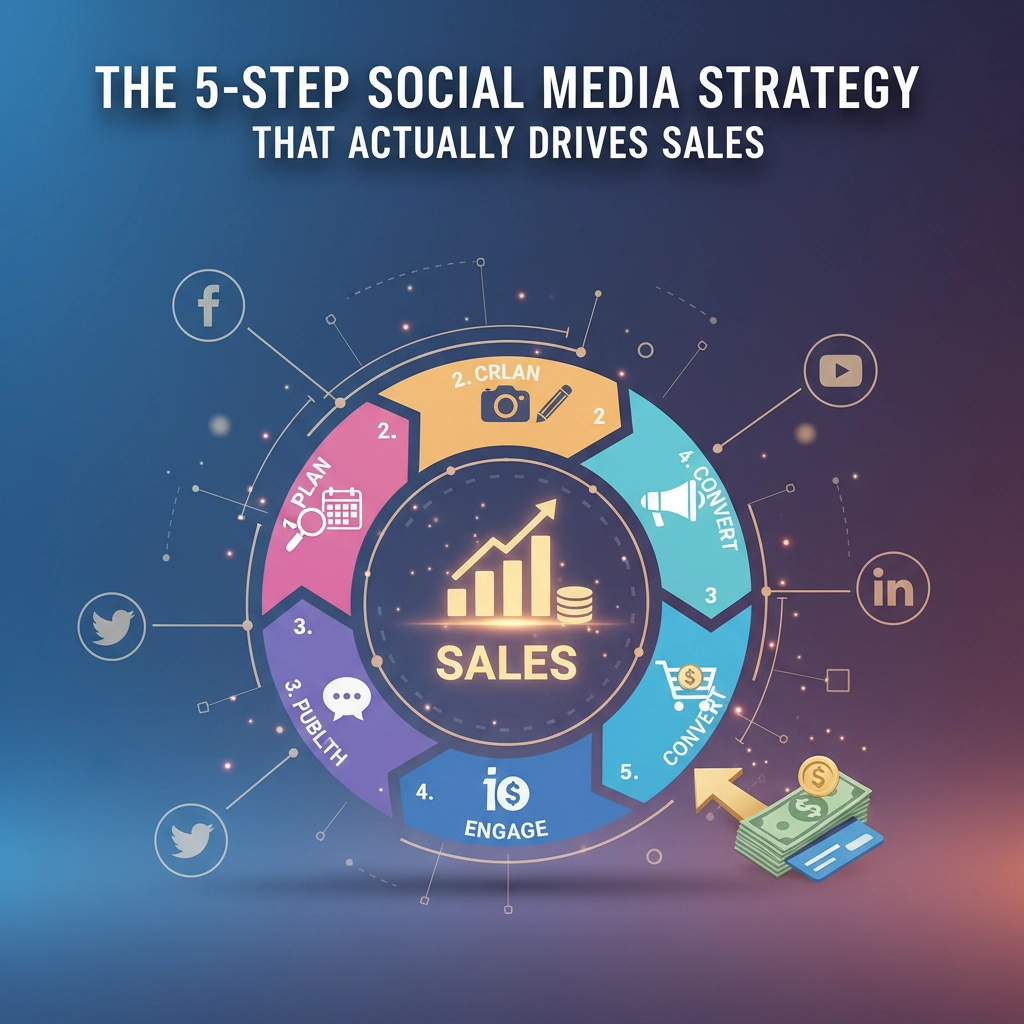
This five-step strategy shifts the focus from guessing to engineering. By defining revenue-focused goals, targeting only the most qualified prospects, creating content that addresses objections, funding only high-intent ad campaigns, and tracking every dollar spent, you will change social media from a distraction into a steady source of income. Stop pursuing fleeting engagement and start building your social media profit center today.